


Most home service companies treat direct mail like a billboard. Buy the biggest list you can afford, send the same postcard to everyone, and hope a few people call.
We think that’s backwards. Today we’re launching the new LettrLabs platform, rebuilt from the ground up around one idea: mail should go out because something happened at a customer’s home, not because it’s the first of the month. A storm rolls through. An HVAC system goes 12 years without service. A new family moves in. A competitor wins a job in your service area. That’s when your postcard should land, and now it can, automatically.
Why direct mail stopped working for so many contractors
If you’ve tried direct mail and walked away unimpressed, you’re not alone. In our experience, it usually fails for three reasons.
The wrong homes. Big, generic lists mean you pay to mail renters, homes outside your service area, and customers who you recently serviced.
The wrong time. Most companies mail on a calendar. Homeowners buy because something happened: a hailstorm, a move, a system that finally gave out. Those two schedules almost never line up.
No proof. Direct mail is the last channel still judged on gut feel. When you can’t show what it brought in, it’s the first thing cut when budgets get tight.
None of those are problems with your mail. They’re targeting, timing, and measurement problems, and that’s what we built the new platform to fix.
Start with a play, not a list
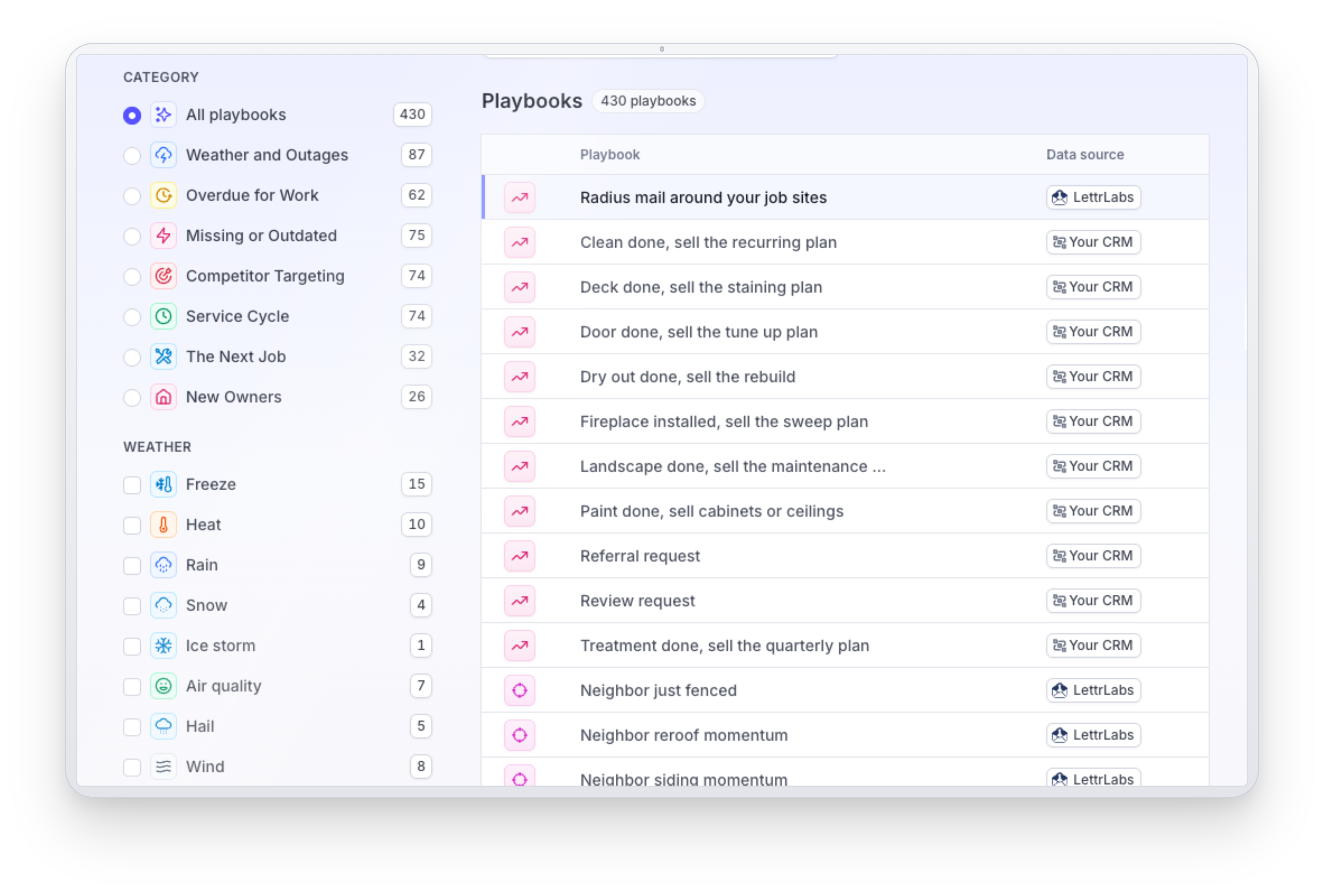
Instead of building a list from scratch, you start with a play: a ready-made campaign that mails a home the moment something happens there. There are more than 400 plays, and you can filter them to show only the ones built for your trade.
- Weather and outages. Heat waves, severe storms, seasonal changes, and power outages, based on actual or forecasted conditions. If your area is about to see three days over 100°F, your AC tune-up cards can already be on the way.
- Property signals. We use building permit records to spot homes that are probably due. No HVAC permit in 12 or more years? That system is likely near the end of its life.
- Competitor activity. Reach homes where a competitor’s job has stalled, where their work from two years ago may be wearing out, or where a competitor just pulled a permit at one of your own customers’ homes.
- The Next Job. Be the first to reach homes for add-on work. New siding job completed? Send an offer for painting. New HVAC installed? Send an offer for insulation or duct work.
- Your own software. Trigger mail from tools you already use, like ServiceTitan and AccuLynx, so a finished job or an open estimate can kick off the right follow-up.
Pick a play, and the platform watches for that moment every time it occurs. You don’t have to remember to pull a list after a storm.
Mail the right homes, and skip the wrong ones
The best mail piece is sometimes the one you didn’t send. Every card that goes to a home you can’t serve is money gone.
So setting up your audience takes a few clicks. Draw your service area as a radius, a custom shape on the map, or a list of ZIP codes, cities, or states, and see how many homes qualify in seconds. Save several service areas if you run more than one territory.
Then narrow it down with the details that matter to you: home value, year built, square footage, how long the owner has lived there, and household income. You can choose homeowners or renters, and when the owner lives somewhere else, you decide whether to mail them at their other address, mail the house, or skip it.
Stay in control of what you spend
Automatic doesn’t mean out of control. Every campaign gets its own monthly budget, set in dollars or in number of cards. Add a cap per event so one big storm can’t use up your whole month.
You also choose how hands-on to be. Approve each send before it goes out, or let campaigns run on their own. And storm campaigns now cost the same per piece as everything else, with no extra charge for the weather data.
See exactly what your mail brought in
This is the part contractors ask us about most. The new platform connects your mail to the jobs it produced, matching leads and signed contracts back to the homes you mailed. Open estimates show up as pipeline, and signed contracts show up as revenue.
You can see it on a map, too: every home you mailed, which ones became leads, which ones closed, and which ones didn’t. Click any home to see its full history with you.
For the clearest answer, turn on a holdout group. The platform sets aside a small share of qualifying homes and doesn’t mail them, then compares the two groups. If the homes you mailed booked more jobs than the ones you didn’t, you know the mail made the difference, not just good luck or a busy season.
Why this is possible now
A few years ago, none of this would have worked. Three things changed.
First, the information finally exists. Permits, storms, power outages, moves, and property details are now available for most homes in the country, and they’re far more accurate than they used to be.
Second, that information can now be used to send mail in a fully automated way. Instead of someone pulling a list after a hailstorm and uploading it a week later, the platform sees the storm and the right cards go out while homeowners still need help.
Third, the results can finally be measured. With holdout groups and a connection to the software you already run your business on, you can see what direct mail brought in, not just guess. Once a channel can prove what it earns, it stops being a cost and starts being a way to grow.
If you’ve been burned before
You weren’t wrong to be skeptical. You were probably mailing the wrong people at the wrong time, with no way to tell what worked. You weren’t burned by direct mail. You were burned by mailing blind.
So don’t take our word for it. Start with one play and a holdout group, and let your own numbers tell you whether it’s working.
Already a LettrLabs customer? Your existing automations carry over automatically, with nothing to set up again. Log in to explore the new plays, or book a demo to see the platform in action.


